
March Madness: Data Science May Illuminate a Path, but It Can’t Always Show Us the Way

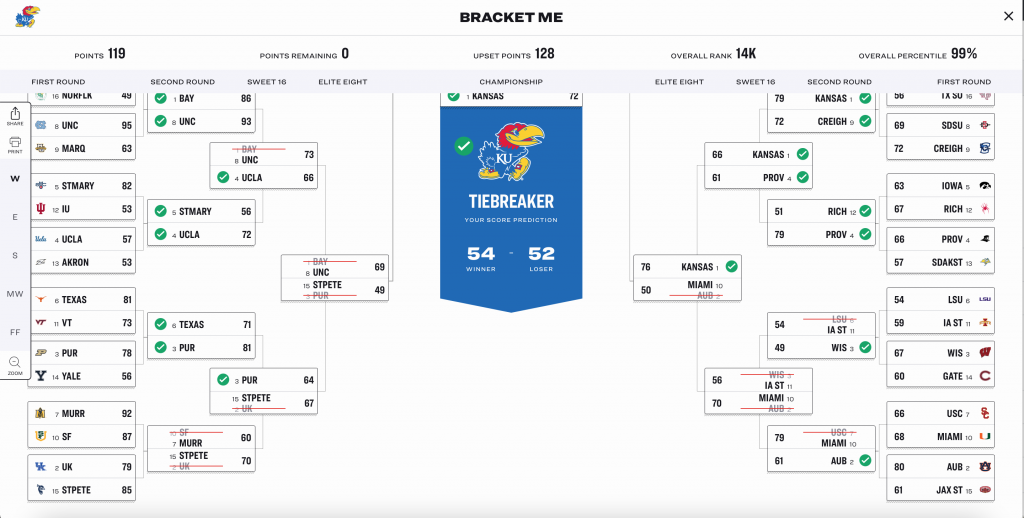
Update: Ultimately, data science prevailed. Kansas won the tournament by 3 points. Here’s the final bracket results:

April 2, 2022

Data lead to a 99 percentile showing ranking in the top 14 thousand brackets placed on CBSSports.com. In final analysis St. Pete was a force to be reckoned with. They started the tournament with a fantastic upset win and was on a tear for three rounds. Them beating Purdue effectively killed the left side of my bracket. I was playing for points on that side and that was it. UNC stunned Baylor in the second round effectively cutting off the bottom left side of my bracket. I rode Gonzaga as far as I could, but Arkansas halted them before they could play against #2 ranked Duke.

I had some stumbling blocks along the right side of the bracket, but my Final Four matchup of Kansas playing Villanova proved out. Furthermore, Kansas’ 16 point win insured I still had a chance to win the big game.

It was fun watching data play out game-by-game. In the end, humans; not machines, show up to play.

Data Science has served my bracket well, but human behavior always exceeds the margin for error.

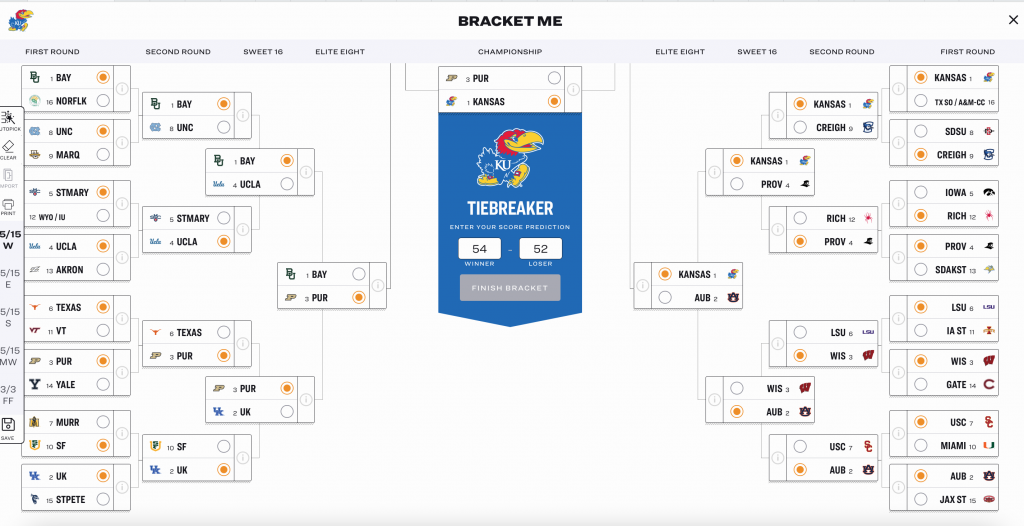
My Bracket on March 21, 2022

It’s been a wild crazy weekend for college basketball fans. There’s a reason why they call it March Madness and we’ve seen it play out in full effect. I’ve made a lot of noise about “The Bracket Picked by Data Science” this year, and for the most part it’s working out, but not every scientific pick has worked out.

My bracket is not broken.

10 of my Sweet 16 picks are still sweet. 6 of my Elite 8 picks are still in. All of my Final Four picks are still in it. Hopefully, to win it.

Now, I did deviate from the math for a couple of picks. Upsets are staple of the Big Dance. My choices against the algorithm have been a mixed bag.

Now that the smoke has settled I’m going to stop and analyze what happened.

The Shocker

The Peacocks from St. Peter’s stunned everyone, including those who picked them, in their upset of Kentucky. 15 seeded teams have only beaten second seeds ten times in NCAA tournament history with a 9-135 record. I felt fine after witnessing this loss. The math has Kentucky losing to Purdue in the Sweet 16, but my points and rankings were compounded later by upsets.

Showing Up to Play

Picking down rank gets more involved and you have look at offensive power to make better picks. Sometimes things look good on paper, but you need the humans to show up and play. UConn lost to New Mexico State in a seven point game that was well played. Juwan Howard led his Michigan team to beat 6th ranked CSU in their corner of the bracket. Iowa State bested LSU by 5 in a close game. Miami beat favored USC by 2. By two points! All were well played games.

Upset Specials

My deviations were…mixed. I chose San Francisco to beat Murray State. It was a delightful game, but they couldn’t mete out a win. Not necessarily an upset, but I did pick #9 Memphis over Boise. I chose Creighton over San Diego, and Richmond to beat Iowa. My 8/9 picks were on, but uggh down rank not so much. In the end, I wound up scoring 52 upset points. UNC bested Baylor in the second round, something I wasn’t expected at all. I had Baylor getting beat by Purdue in the Elite 8.

There you have it.

Right now, I’m still ranked in the top 94% of the millions of brackets filed. We’ll see what happens this week.

You can cheer and cry along with me by checking out my bracket at NCAA.com.

It’s March! The James Webb Space Telescopes Sends First Images, Technology’s Impact on Ukraine-Russian War, Kaspersky Pledges Neutrality

Happy Thursday, TTN readers! Kiss me, I’m Irish! I’m on with  Mark Starling, John, and the First News 570 crew. This week’s top tech stories: Read a brief commentary on the impact of technology on the Ukraine-Russian War, Kaspersky Wants to Remain Neutral, and the James Webb Space Telescope sends its first images. You can listen to Mark and I point and laugh while talking about the wild and crazy technology world every Thursday morning, LIVE at 6:43am Eastern by tuning into WWNC on the iHeartRadio app.

Yes, it’s March which means betting. This year, gambling experts are predicting $3.1 billion will be bet on March Madness, which is down from 2019’s $9.1 billion shifting hands. Experts are also saying that this year’s betting may represent the largest “legal betting” on the tournament. The number may actually trend downward due to the onslaught of legal sports book apps on the market. There’s just something exciting about getting in on a little wager without the middleman.

Behold, the bracket built using data science.

My Bracket: Data Science Will Win the Day

Anyway, onto this week’s real stories.

WHO WATCHES THE WATCHMEN

Kaspersky, the Russian computer antivirus company has planned to open a data center in Switzerland to demonstrate they’re not a Russia spy factory. Kaspersky makes antivirus software that used to run everywhere, including the US government. Last year, the Biden administration banned the use of Kaspersky products at US government agencies accusing the company of being a Russian spy organization. Monday, the Dutch stopped using their products. And then, Germany. And so on. CEO, Eugene Kaspersky, is moving to Switzerland because of its policy of neutrality and data privacy laws. Kaspersky has over 400 million users. They have proclaimed they are not agents of Russian intelligence.

COMMENTARY: THE IMPACT OF TECHNOLOGY ON THE WAR ON UKRAINE

The war in Ukraine is a tragedy and humanitarian crisis. The Ukrainian government and its people have been very strategic and savvy with their use of technology. Ukrainian president, Volodomyr Zelenskyy, a former actor who played Ukraine’s president on TV; has used the immediacy of mobile photo and video, social channels, and cryptocurrency networks effectively in pushing Russia into isolation. At times pleading, at other times graphic the Ukrainian government has put on a PR campaign that would envy many organizations. Live streams and TikTok were used to spread propaganda fronting Russian soldiers who were against the war and want to go home. Influencers have gone from frivolous topics like fashion and NFTs to showing bombs falling outside of their window. Americans have seen wars televised after the first and second Iraq Wars, and the war in Afghanistan. Those projections of war were polished coming from embedded journalists carrying high def cameras. Americans have never seen war from the first person, and for the first the true tragedy and loss of life is capture using a device all of us carry around for granted. I don’t think a more effective campaign of communicating your aims has been made since the Civil Rights era. Currently, it’s not possible to trade rubles for dollars, and Russia is losing its grip on containing information that doesn’t ride the party line.

JAMES WEBB SENDS FIRST IMAGES

After a long delay and much fanfare, NASA shared the first images coming from the James Webb Space Telescope. The James Webb uses new technology to capture imagery on the infrared spectrum and can look farther at dimmer objects than the Hubble telescope. The mission launched on Christmas Day, 2021 and the second phase of the mission involved aligning the two sets of mirrors used for gazing into space. The telescope’s mirrors are a collection of many smaller mirrors that need to be in proper position for making clear photos. That day came yesterday and it’s an exciting time to view distant space.

Thanks for checking out Top Tech Stories of the week on First News 570. I truly enjoy providing insight for our audience. You can always get the Top Tech Stories by signing up for the newsletter.

Also, be on the lookout for a new podcast, The Cloud. Digital Technology. Decoded.

Crypto Plays Big in Ukraine, Uber Eats Causes Millennials to Rejoice, and Huawei…Again

Happy Thursday, TTN readers! My oh my, what a week has it been. I’m on with  Mark StarlingSeth, John, and the First News 570 crew. This week is dominated by Ukrainian associated tech news. Board members resign from battered Huawei, millions are sent to Ukraine over the crypto chain, and millennials rejoice for new Uber Eats functionality . You can listen to Mark and I point and laugh while talking about the wild and crazy technology world every Thursday morning, LIVE at 6:43am Eastern by tuning into WWNC on the iHeartRadio app.

MILLIONS IN CRYPTO HEAD TO UKRAINE

On multiple occasions on multiple projects, I’ve worked with Ukrainian software engineers and I’ve had delightful experiences. My first officemate at my first post-grad job IBM was Ukrainian. Ukraine produces lots of top notch software talent, and over the years has produced some of the world’s top cryptocurrency developers. (One of the blockchains I’ve used was born in Ukraine) Illia Polosukhin has led a movement to help send donations back to his home via blockchain technologies including his NEAR protocol. All told, about $50 million in cryptocurrency have been given to wallets located in Ukraine. This news coming hot on the heels of the Biden administration signing an executive order to regulate cryptocurrency. After facing mounting sanctions Russia has worked to sidestep them by trading on the previously unregulated crypto exchanges.

MILLENNIALS REJOICE AS UBER EATS DELIVERS ON BILL SPLITTING

Have you ever gone out to eat with a group of millennials and stuck around for the check? Millennials who don’t work in accounting become actuaries and masters of double entry. Splitting a check 20 ways isn’t uncommon. Uber Eats has answered the prayers of broke millennials everywhere and has brought ‘splitting-the-check’ to their app. The upgrade will allow you to set spending limits for your group bill, order different items, and your food will arrive at the same time. The app is perfect for the person who winds up bridge financing hungry 30-somethings. The upgrade is available now.

HUAWEI BOARD MEMBERS RESIGN OVER COMPANY’S SILENCE ON UKRAINE WAR

Huawei, remember Huawei, the banned-by-US Chinese technology company? Two non-executive board members, Sir Andrew Cahn and Sir Ken Olisa, have resigned from Huawei’s board of directors over the company’s silence for not condemning Russia’s invasion of Ukraine. These resignations come as much of the world is condemning Russia’s war with Ukraine, and for Huawei the company found itself drawing much of President Trump’s administrations ire. The US had banned government entities from purchasing Huawei equipment and the US went on a worldwide campaign to have other nations follow suit. Huawei has found itself at odds with the US again. The US has put Chinese companies on notice for exporting high tech to Russia. Thing is, China and Russia have been getting more and more cozy with each other, and China has remained silent themselves.

Coming soon! Listen to The Cloud, a new podcast that dives deeper into tech.

Western Hackers Strike Back, Companies Unite with Citizens to Quit Russia, Amazon to Close a Bunch of Stores

Happy Thursday, TTN readers! My oh my, what a week has it been. I’m on with  Mark StarlingSeth, John, and the First News 570 crew. This week: Russia dominates tech news. The Hacktivists Strike Back against Russian military targets, Amazon plans to close physical store locations, and a plethora of companies quit Russia. You can listen to Mark and I point and laugh while talking about the wild and crazy technology world every Thursday morning, LIVE at 6:43am Eastern by tuning into WWNC on the iHeartRadio app.

RIA-Novosti’s Victory Editorial

HACKERS TARGET RUSSIAN INFRASTRUCTURE

Three days ago, Anonymous, that Anonymous asked the hackers of the world to attack Russian infrastructure. The world responded and a number of Russian military assets were hit. Hackers heeding Anonymous’ call have attacked Russia’s satellite infrastructure, other hackers have released the personal details of Russian military soldiers, and the hits keep coming. Parties in the US and other nations were getting prepared for any Russian cyber attacks that may come. This week’s events have prompted cyber warriors to unite and Hack the Russians. The Ukrainian government has encouraged hackers to take up their cause. 500 volunteers have signed on so far.

Bonus: Who is Anonymous?

No one knows for sure. Anonymous is a group of hactivists who use their computer skills to target popularly identified individuals, organizations, and nations that do heinous things or are not considered good public citizens. Who knows how Anonymous decides to carry out campaign. The key to understanding groups like Anonymous is that you may agree with their actions today, and may disagree with their actions tomorrow.

AMAZON TO CLOSE PHYSICAL STORES

Amazon announced plans to close 68 of its Amazon Books, 4-Star, and Pop Up stores across malls and locations in America. The company wants to focus its energies on grocery stores and fashion outlets instead of other stuff. The 4-Star locations specialized in selling curated 4-star rated products from Amazon.com and we have all seen Amazon Pop Ups in the mall during Christmas. As the nation’s largest bookseller, it is interesting Amazon decided to pull out of selling books in brick and mortar.

COMPANIES UNITE WITH CITIZENS IN RUSSIA BAN

Say what you want to say, but the power of the Internet is a mighty thing. A plethora of global corporations have taken action in protest of Russia’s invasion of Ukraine. The list of companies is spread wide across a number of industries and seems to be growing everyday. Apple has stopped sales of its products and services in Russia. Netflix has told Russian regulators it will not comply with new rules to carry state sponsored streams. Electronic Arts has removed Russia from its FIFA22 soccer game. What company hasn’t hopped on the bandwagon, Binance. Binance has ruled out banning ordinary Russian users from using their crypto exchange platform.

Bonus: The Internet is Forever

The state-backed Russian news agency, RIA-Novosti, deleted an editorial piece praising Russia’s victory of Ukraine. The editorial appears to have been posted on February 26, and its content expressed praise for Russia’s swift victory over Ukraine. The news agency tried to remove the article, but it was cached by the Internet Archive in time for Net snoops to find it. If anything, regardless of your political stripes, if you’re in America this should make you feel more appreciation for a free press. Regardless of your leaning.

Have an awesome weekend! Don’t forget to sign up and receive TTN in your inbox.

Russian Hackers Warm Up as Ukraine Heats Up, Uber and Lyft Enter the Medical Game, Meta Unleashes New Virtual Tools

Happy Thursday, TTN readers! Chips (not chocolate) and privacy take center stage this week. I’m on with  Mark StarlingSeth, John, and the First News 570 crew. This week: Uber and Lyft get into the medical game, Russian hacker groups warm up as Ukraine crisis deepens, and Meta CEO unveils knew metatools. You can listen to Mark and I point and laugh while talking about the wild and crazy technology world every Thursday morning, LIVE at 6:43am Eastern by tuning into WWNC on the iHeartRadio app.

LYFT AND UBER GET INTO THE MEDICAL TRANSIT GAME

Regardless of where you fall politically you have to admit the US health system is broken beyond repair. Over the last couple of years the ridesharing companies have been giving rides to low-income medical patients in the Non-Emergency Medical Transportation market. The NEMT program is used by hospitals and other health providers to provide transit for non-emergency patients. NEMT services are normal provided through dedicated companies, but Uber and Lyft are vying for a slice of the $3 billion marketplace. On the surface, this isn’t a bad idea. The problem however arises when NEMT drivers have basic medical training to support their customers. Drivers who weren’t ready to pick up patients have reported having to support elderly patients in ways they were trained for. Cheap ain’t always better.

FACEBOOK, UH META, UNVEILS NEW TOOLS FOR THE -VERSE

Yesterday, Meta CEO, Mark Zuckerberg announced and demoed several new tools Metaverse users can use to build out their virtual worlds. One of the first tools is the Builder Bot. The Builder Bot can be used to build out an island or patch of virtual real estate. Zuckerberg also announced an AI-powered universal translator giving Metaverse denizens the ability to communicate with anyone in real time. Meta’ AI unit is led by none other than Yann LeCunn one of the early pioneers of AI and inventor of check bank account number scanning tech. Meta isn’t just receiving cheers however, women who have become early adopters of the met averse have already reported harassment which led to one of the first implemented features to be a Personal Boundary. Early Facebook investors are telling the company that it’s their responsibility to NOT build a dystopian virtual universe. I’m like, don’t we already have that in Facebook?

RUSSIAN HACKERS WARM UP AS UKRAINE CRISIS HEATS UP

To be filed in the, We Knew This Was Coming Column, the Sandworm group, the Russian government’s hack-attack unit has been using a firmware hack to infiltrate home and small business routers. The malware called Cyclops Blink has infected 1 percent of the world’s small scale firewalls and routers. The overarching idea is that important people have home networks too, and someone will get caught in their snare. So far Cyclops Blink has only targeted WatchGuard brand of devices. Sandworm has a respectable pedigree as a hacking group. They’re exploits have shutdown parts of Ukraine’s power grid, wiped out billions of disk drives around the world, and knocked out parts of the 2018 Winter Olympics.

Have a great weekend, and don’t forget to sign up for Top Tech News of the week!